


You can notice it everywhere: 3D printing is shifting from experiment to daily practice. More and more schools, design studios, and hobby workshops are choosing a PLA filament 3D printer as their first step. That is no coincidence. Unlike exotic plastics, PLA hardly requires any odor extraction, achieves excellent results at room temperature, and consists largely of renewable raw materials such as corn starch or sugarcane. In this blog (approx. 1,500 words), you will discover why the combination of PLA and a modern printer is not only user-friendly for beginners, but also a sustainable choice in an era where material circularity and energy consumption are becoming increasingly important.
What makes PLA different from ABS or PETG?
Chemically speaking, polylactic acid is an aliphatic polyester with relatively short chains. That has two concrete advantages for you as a user. First, PLA melts around 190 °C; your hotend therefore needs to heat up less than with ABS (± 240 °C) or PETG (± 230 °C). A lower nozzle temperature means less power consumption and less thermal wear on the heating block. Second, PLA does not emit styrene vapors during the phase transition. You can therefore easily operate a PLA filament 3D printer in an office environment without complex filtration. An additional plus: the shrinkage coefficient of PLA is low. Prints adhere firmly to a flat glass or PEI bed without you having to deal with corners curling up (warping). This makes larger objects with thinner walls achievable than with many other thermoplastics, even without an enclosed build chamber.
The ecological perspective
The ‘bio-based’ label does not automatically mean ‘biodegradable in the garden’. Degrading PLA requires industrial composting conditions (60 °C, increased humidity, active microflora). Nevertheless, the CO₂ footprint is demonstrably lower than that of petroleum-based polymers. A research report by NatureWorks calculated that the production phase of PLA consumes 75% less fossil energy than ABS. If you combine that with refill spools available at AC PRODUCTS under the PLA-Re label, you also save on the large plastic spool. For educational institutions and SMEs that want to make their CSR reporting more serious, a PLA filament 3D printer is therefore a logical step.
Choosing a printer: what should you look for?
Not every machine gets the most out of PLA. Key points:
- Nozzle material: brass is sufficient for standard PLA, but a steel nozzle wears out less quickly with PLA-CF.
- Hotend design: a full metal heatbreak prevents heat creep; your filament remains firm until it reaches the melting point.
- Cooling duct: PLA benefits from active part cooling. A dual 5015 fan can harden the layer immediately after extrusion, which produces sharp bridges and overhangs.
- Firmware options: input-shaping in Klipper or Dynamic Acceleration in Marlin reduces vibration marks; your glossy PLA-Silk will then truly look as if it were cast.
With these criteria, you can quickly find a model in the €300–€800 price range that will serve perfectly as a PLA filament 3D printer.
Print settings for first-layer success
The first layer remains the Achilles' heel of any 3D print. For PLA: bed at 55 °C, nozzle at 200–205 °C, fans off on layer 0 and on (100%) from layer 2 onwards. Set your Z-offset so that the extrusion is slightly "flattened." For Creality machines, use the CR-Touch mesh; with Bambu Lab, the lidar scan provides a virtual spirit level. A well-placed skirt helps the nozzle build up pressure, which prevents clumps, especially with PLA-CF.
Support material and removability
PLA is easily supported by PVA or BVOH water-soluble co-polymers. In a dual extrusion PLA filament 3D printer, you can print complex cavities without brittle support; one night in lukewarm water and the support dissolves like sugar. Those with only one nozzle are best off choosing ‘tree supports’ in Cura or ‘organic supports’ in PrusaSlicer. They only touch the model at a few points, which requires minimal post-processing after drying.
Post-processing and mechanical improvements
A misconception: that PLA is brittle. That was true for the early 2010s stuff. Nowadays, you can anneal your prints. Heat the oven to 80 °C, place the part on baking paper for 30 minutes, and let it cool down slowly. The crystalline phase increases, heat resistance rises from 60 to 90 °C, and impact strength goes up by 1.5x. Keep in mind there will be 2% shrinkage. AC PRODUCTS offers a free spreadsheet where you can automatically enlarge hole diameters so they have the correct fit after annealing. A coat of primer and a matte acrylic varnish further transform the appearance. PLA adheres well after light sanding (400 grit). This way, your workpiece will look more like CNC-milled than 3D-printed.
Costs versus returns
A kilo of standard PLA costs ± €20. A complex prototype of 200 g of filament and 6 hours of print time consumes €1.50 in electricity (at €0.40/kWh and 120 W average). Total variable costs: €5.50. An external 3D service bureau often charges €35–€40 for the same part. If you invest €500 in a PLA filament 3D printer, the break-even point is reached after 15 prints. For schools and labs, this means: after one semester, the machine pays for itself.
Storage and moisture management
PLA is less hygroscopic than Nylon, but it still absorbs 0.5% water in 48 hours in high humidity (70% RH). Store open spools in a dry box with silica gel. Set the temperature to 40 °C if you really want to pay attention to detail: this way, your PLA filament 3D printer will print the hundredth layer just as flawlessly as the first.
Recycling and circularity in practice
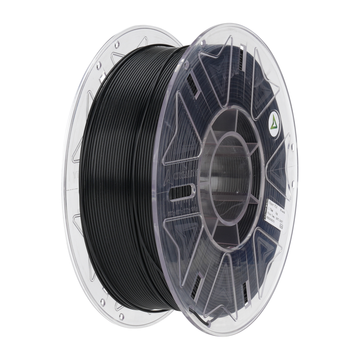
Many suppliers talk about recycling, but AC PRODUCTS actually does it. Scraps and failed prints go into a shredder, are washed, and mixed with 30% new PLA. We extrude the granulate into PLA-Re. This reduces the CO₂ impact per kilo of filament by 25%. Customers receive a 10% discount when they hand in 2 kg of print waste. This is how your PLA filament 3D printer moves from linear production to a quasi-closed loop.
Case study: Design agency for orthopedic aids
A startup in Rotterdam designed custom braces. Initially, they outsourced their prototypes and waited five days for delivery. After purchasing two Bambu Lab P1P machines set up as high-speed PLA filament 3D printers, they were running six prototypes a day. Customers could scan in the morning and fit in the afternoon. Time to market dropped from five weeks to nine days. The investment (€2,000) paid for itself within three months.
Future perspective
Researchers are developing PLA blends with modified isosorbide units for heat resistance up to 120 °C without the need for annealing. There are also PLA elastomers coming that reach 400% elongation—the sweet spot between TPE and rigid PLA. Your current PLA filament 3D printer can usually handle these materials without a hardware upgrade, because the base temperatures remain the same.
Conclusion: PLA as a solid foundation for sustainable 3D printing
The puzzle of material selection, printer settings, and ecological ambitions comes together surprisingly simply when you start with a PLA filament 3D printer. You benefit from low energy costs, minimal vapors, and a growing range of functional and artistic variants. By storing smartly, annealing regularly, and sending leftover material back to AC PRODUCTS, you make your entire print workflow future-proof and environmentally friendly. Do you have any questions, or would you like to test a sample of PLA-Re? Feel free to drop by our showroom in Utrecht or send us an email. Our team is happy to help you make every layer and every step in the chain just a little greener and more professional.


Leave a comment