


You have been following developments in filament printers for some time. You know that FDM machines typically require a compromise between print speed, detail, and ease of use. In 2024, however, the Bambu Lab P1S Combo turned the market upside down by combining industrial build quality, multi-color functionality, and lightning-fast accelerations into a single desktop platform. The result: prototypes or end-use parts on your workbench sooner without having to sacrifice surface quality. In this guide, you will discover exactly how that works and what it can mean for your production process.
Core concept: Speed through mechanical rigidity
Where traditional FDM printers often print at around 100 mm/s to limit vibrations, the Bambu Lab P1S Combo accelerates to 20,000 mm/s² and achieves production speeds of up to 500 mm/s. That may seem like magic, but the secret lies in an extremely rigid Core-XY configuration, linear rail guides, and an aluminum frame with reinforcing steel plates. Because the print head moves in two axes simultaneously, you minimize inertia effects. The built-in micro-lidar system compensates for micrometer variations in layer height, ensuring that high speeds do not lead to visible banding.
Accuracy: Measuring is knowing
Fast printing is only useful if the model fits. The Bambu Lab P1S Combo uses lidar to scan the first layer and corrects the nozzle offset in real time. In addition, Hall sensors calibrate the Z-offset for every print job. This allows you to achieve tolerances of ±0.05 mm in technical materials such as PETG-CF. The machine logs all sensor data; via Bambu Studio, you can see exactly where deviations occur. This makes it easy to iteratively adjust slicer parameters for optimal fit without having to head to the measuring room.
All in one ecosystem
Unlike loose upgrade kits, the Bambu Lab P1S Combo offers a turnkey package: printer, AMS multi-color module, and HEPA activated carbon filter in one box. That integration means you don't have to figure out firmware or cable management; the machine is ready for calibration runs within twenty minutes. The proprietary slicer, Bambu Studio, automatically recognizes the device via LAN or Wi-Fi, so you can start, pause, and monitor print jobs from your desk or even remotely via the Bambu Handy app.
Key specifications at a glance
The printer features a build volume of 256 × 256 × 256 mm and achieves print speeds of up to 500 mm/s with an acceleration of 20,000 mm/s², while the all-metal hotend can handle temperatures up to 300 °C and the heated bed reaches up to 110 °C thanks to a flexible PEI plate. An integrated lidar scanner monitors the first layer for height deviations and detects misprints such as ‘spaghetti’ formation, while the AMS system automatically switches between up to four different materials or colors. Despite this powerful hardware, the noise level remains below 50 dB in standard mode, performance previously considered possible only with industrial equipment.
Multi-material without the headache
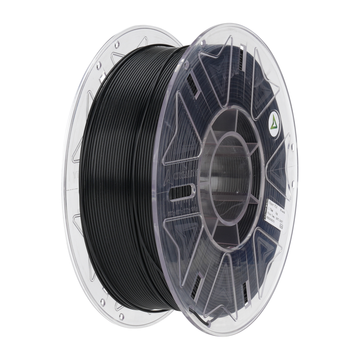
Thanks to the AMS station, the printer automatically switches filament spools and determines which material parameters are appropriate via RFID. PETG support for ASA? Or a TPU seal in a PLA housing? The Bambu Lab P1S Combo loads, purges, and resumes without manual intervention. The purge tower optimization in Bambu Studio reduces material waste, ensuring multi-color prints remain economically viable.
Cost and time analysis
Let’s take a concrete example: a functional bracket (120 g PETG-CF) for a series of thirty pieces. A conventional printer at 100 mm/s takes five hours per piece; the Bambu Lab P1S Combo completes the same bracket within two hours, including support and cooling cycles. For thirty pieces, you save 90 hours of machine time and approximately 20 kWh of consumption. Add €0.25 per kWh to that and you can see that the ROI of this machine, with a purchase price around €1,099 excl. VAT, is reached within a few months.
Comparison with competitors
Prusa MK4, Voron 2.4, and Creality K1 Max are popular alternatives. While the Voron achieves comparable speeds, it requires self-assembly, tuning, and separate AMS solutions. The K1 Max offers volume but lacks lidar compensation and official multi-material integration. The MK4 excels in community support and print quality but is stuck at 250 mm/s. If you want turnkey speed, multi-color, and accuracy in one package, the Bambu Lab P1S Combo is in a class of its own.
Maintenance and reliability
High speeds mean more wear and tear, but the linear rails are equipped with self-lubricating bearings. A drop of oil monthly according to the QR maintenance guide is sufficient. Firmware updates arrive via OTA, so you don't have to swap SD cards. In practice, AC PRODUCTS registers less than 2% downtime per thousand print hours on the Bambu Lab P1S Combo, partly thanks to the fail-safe function that activates print hibernation during power outages.
Safety and environment
The closed chassis and the HEPA and activated carbon filters reduce fine dust and VOCs—a must in tight workspaces. The printer also automatically switches to Eco mode after a print is finished, saving energy. Because the Bambu Lab P1S Combo is compatible with recycled PLA and PETG, you can further reduce your material footprint without compromising on layer adhesion.
Use cases: From prototyping to end-use production
From rapid prototyping in an engineering studio to small-series production for artists and makerspaces, the device proves itself in diverse environments. Design departments bring functional housings or mechanical brackets to the table within hours, artists print multi-colored objects effortlessly without post-painting, educational institutions let students experience the principles of STEM live thanks to short print cycles, and shared workspaces offer their members production quality without complicated operation. The collective benefit is a drastic reduction in lead time and less manual post-processing, allowing ideas to be ready for market introduction or exhibition sooner.
Financing and service via AC PRODUCTS
As an official distributor, AC PRODUCTS not only provides the Bambu Lab P1S Combo but also leasing options from €38 per month and a 48-hour swap guarantee in the event of critical failure. Training and color profiling are included in the setup package, ensuring your team produces with confidence from day one. You skip the learning curve and immediately benefit from the high-speed workflow.
Frequently asked questions in a nutshell
How many sessions are needed to calibrate the machine? A six-minute automatic routine. Can I print abrasive filaments? Yes, the hardened steel nozzle of the Bambu Lab P1S Combo is designed for carbon and glass-filled materials. How loud is the printer? In Standard mode 48 dB; in Silent mode 40 dB, comparable to a refrigerator. Does the machine fit on a shelving unit? With dimensions of 389 × 389 × 457 mm, yes, but ensure 10 cm of extra space for cooling air.
Conclusion: speed and precision harmoniously united
If you thought FDM printing was always a trade-off between speed and accuracy, the Bambu Lab P1S Combo proves otherwise. Thanks to a rigid Core-XY, lidar-controlled calibration, and picosecond recording of vibrations, the machine delivers serious production speeds without sacrificing detail. Add in the integrated AMS, solid service from AC PRODUCTS, and the favorable ROI, and you have a desktop printer that rivals industrial solutions. Take the step toward lightning-fast, accurate, and multi-color 3D production today; your competitors aren't waiting.



Leave a comment