


You no longer have time for hobby-grade printers that warp unexpectedly, require hours of calibration, or stop halfway through a job. You are looking for a machine that can deliver prototypes, functional parts, and even small batch productions within a single workday without constant adjustments. The Bambu Lab X1 Carbon is designed exactly for that scenario. In this comprehensive guide (approx. 1,500 words), you will read why this CoreXY printer distinguishes itself from anything you have tried before, how it integrates into a professional workflow, and what concrete gains you will achieve in speed, accuracy, and operational reliability.
Why CoreXY works here
You know the principle: in a CoreXY architecture, two belts move in a kinematic grid, allowing the print head to accelerate at lightning speed without the print bed moving. In practice, many manufacturers fail to actually deliver on these high speeds—resonances in the frame construction or slack in the belts still lead to ghosting or dimensional errors. The Bambu Lab X1 Carbon fundamentally solves this: the frame consists of CNC-machined extruded aluminum, reinforced with carbon fiber plates at the corners. This keeps the printer stiff enough at 20,000 mm/s² acceleration to hit 500 mm/s without visible ringing. For you, this means: you can print a 250-millimeter-high enclosure in one long afternoon instead of an entire weekend.
Build volume versus footprint
With a build volume of 256 × 256 × 256 mm, the Bambu Lab X1 Carbon is compact enough for a desk, yet large enough for helmet scale models, drone frames, or complete robotic grippers. The cube shape makes efficient use of the Z-space; the Z-axis is driven by a precision ball screw instead of a lead screw, which minimizes play and virtually eliminates backlash.
Extrusion without a hitch
A high-speed printer is only as good as its extruder. The Bambu Lab X1 Carbon uses a direct drive system with a dual-gear set (hardened steel, making it wear-resistant for abrasive fiber filaments). Filament coupling occurs at a 45° angle, keeping the feed path very short—ideal for TPU or other flexibles. The all-metal hotend reaches 300 °C and features a hardened steel nozzle; you can swap it without disassembly thanks to a quick-swap mount. This saves time and prevents thread wear.
Enclosed, actively heated build volume
Professional materials require a stable climate. ABS, ASA, Polycarbonate, or glass fiber-reinforced nylons warp as soon as the ambient temperature fluctuates. The Bambu Lab X1 Carbon maintains an internal climate between 45 and 60 °C via a smartly controlled chamber heater. Sensors measure the temperature at six points every three seconds; a PID algorithm corrects it with quiet ceramic heating elements. This keeps the entire model stress-free from the first layer to the top layer. You can print dashboards, mechanical enclosures, or even impellers without warping or delamination.
AMS: Filament management reinvented
A unique part of the Bambu Lab X1 Carbon is the AMS (Automatic Material System). Four, optionally eight, spools sit in a sealed cassette with humidity control. Each filament has an RFID tag; as soon as you send an STL to the slicer, you see in real time which colors or materials are available. During the print, the AMS switches spools within ten seconds without any purge tower drama: a special sliding tray catches the transition drops, keeping waste minimal. Multi-material printing—think of a PLA body with TPU dampers or a PETG housing with PVA support—becomes a matter of a single workflow choice for you, rather than a whole evening of preparation.
AI-powered first layer inspection
Everyone knows: the first layer is king. The Bambu Lab X1 Carbon includes a LIDAR sensor that compares the height of the extruded filament line with the theoretical width. If the line is too wide (nozzle too close) or too narrow (nozzle too high), the printer stops automatically after the first loop and asks for an adjustment. You no longer need to lean over and squint at the first three rows—the system monitors itself.
Safe filtration for professional use
At temperatures above 240 °C, fumes and ultrafine particles are released that you do not want to inhale continuously. That is why the Bambu Lab X1 Carbon comes standard with a HEPA filter plus an activated carbon filter. The air circulates internally and only exits the cabinet after cleaning. As a result, the device complies with stricter office standards for fine dust, and the workspace still smells neutral after ten hours of printing.
Whisper-quiet ventilation
The fans in the enclosure are PWM-controlled and modulate based on heat requirements. Below 50 °C, they run at a low speed, making the printer barely audible indoors. Above 50 °C, they switch up, but the noise level remains below 50 dB—comparable to a quiet refrigerator.
Workflow with Bambu Studio and Cloud
Bambu Studio, based on an open-source slicer engine, is optimized for the Bambu Lab X1 Carbon. You can import STEP, OBJ, or STL files directly, select a material profile, and see the inventory for each material spool at the bottom of the screen. Via Bambu Cloud, you send G-code directly to the printer, monitor progress via the built-in 1080p camera, and receive push notifications for filament changes or when the print is finished. You don't have to stay near the machine; the workflow fits into a busy office or lab environment.
Maintenance in minutes
A printer for professionals must be reliable and low-maintenance. The Bambu Lab X1 Carbon requires only a brief inspection every 200 print hours: lubricate rails with the included oil, check the HEPA filter, and clean the nozzle with a cold-pull filament. All essential parts are modular; you can replace a hotend in two minutes, a fan in five. Furthermore, AC PRODUCTS supplies all spare parts from stock, including stepper motors and AMS components.
A core list: The biggest pros summarized
- Speed & volume: 500 mm/s printing within 256³ mm build space
- Advanced extrusion: direct-drive, all-metal up to 300 °C, quick nozzle swap
- Actively heated chamber: stress-free printing of engineering plastics
- AMS system: four to eight spools, moisture control, smart color switching
- AI & LIDAR: first-layer inspection and flow automatically adjusted
- Professional filtration: HEPA + activated carbon for clean workspaces
- Robust construction: carbon-reinforced frame, linear rails, quiet performance
Practical case: Arm prosthesis in one workday
A startup in medical devices designs 3D-printed forearm prostheses. Previously, they produced sleeves in five separate parts on standard FDM printers, followed by gluing and post-processing. With the Bambu Lab X1 Carbon, they printed an entire sleeve from PETG-CF in six hours, directly in the desired color. After twelve prototypes, the printer had already paid for itself through saved labor time and outsourced print work.
Material library from AC PRODUCTS
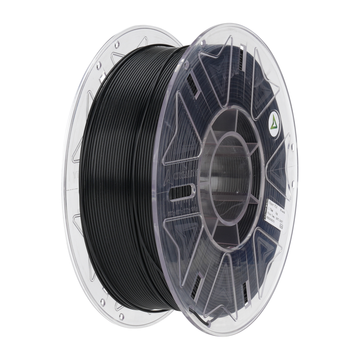
For every supported filament, AC PRODUCTS has a validated profile: PLA-Basic, PETG-Engineering, ASA-Outdoor, PA-CF-Pro, and TPU-Flex 95A. Each profile contains temperature curves for both the hotend and the heated chamber, plus the optimal retraction settings. As a result, you don't have to waste boxes of filament experimenting; you load the material and immediately see consistent results.
Reliability, tested for the long term
Before launch, Bambu Lab subjected the printer to a 1,000-hour 24/7 stress test: alternating ABS cubes and nylon gears at maximum speed. Only one component—a fan bearing—failed, which has since been replaced with a more robust model. AC PRODUCTS repeated a shortened 300-hour test and achieved zero failures. You can therefore confidently run a multi-day job without overnight checks.
Scalable in a print farm
Thanks to Wi-Fi network management, you can link up to 20 Bambu Lab X1 Carbon devices in one dashboard. Bambu Studio automatically distributes jobs based on material and print time. This way, you grow from one printer in a workshop to a full-fledged micro-fabrication line without taking the step to industrial half-million-euro machines.
Putting the investment into perspective
The recommended retail price of the Bambu Lab X1 Carbon is higher than that of typical hobby printers, but lower than many comparable professional CoreXY systems. Calculation: a prototype that takes two days on a standard printer can now be printed in eight hours. Three shorter lead times per week can quickly save you 100 engineering hours per year. At a cost of €75 per hour, the payback period is less than twelve months, excluding the extra margin you gain from accelerated iteration.
Integration without a steep learning curve
Do you already use Cura, PrusaSlicer, or Simplify3D? Then you can import the G-code for the Bambu Lab X1 Carbon via a post-processor script. If you are new, Bambu Studio helps you with wizard profiles: you choose material and layer height, fill in the infill ratio, and the software generates support based on AI-recognition of overhang angles. You don't have to be an expert to deliver professional output.
Aftercare and community
If you buy from AC PRODUCTS, you get a two-year carry-in warranty, telephone support during office hours, and access to an active Discord community. We test software updates in advance, so you don't run the risk of firmware bugs yourself. In addition, AC PRODUCTS organizes quarterly webinars with best-practice tips for the Bambu Lab X1 Carbon, ranging from multi-material design to maintenance training.
Conclusion: Ready for industrial performance
Whether you are a product designer, researcher, or small-batch producer: the Bambu Lab X1 Carbon gives you high-end print speed, material freedom, and process reliability in a compact format. The AMS system, active chamber heating, and AI-driven quality control make every print a predictable success. Thanks to the workflow integration via Bambu Studio and Cloud, the printer fits seamlessly into modern, digital product development. Order today from AC PRODUCTS and experience how you can set a new standard for your own print output and your customers' expectations with the Bambu Lab X1 Carbon.


Leave a comment