


You are about to print a series of prototypes, but without a plan, it is highly likely that their strength, appearance, or dimensions will fall short. That is why every printing project at AC PRODUCTS begins with an intake session to define the goal, stress levels, and finishing requirements. Once that is clear, we select one suitable filament instead of blindly grabbing the first roll off the shelf. This approach saves time, prevents waste, and results in a predictable process that gets it right the first time.
Formulate the intended use as concretely as possible
A static model has different requirements than a hinge in a robot arm. Weight, impact resistance, and lifespan determine which polymer will perform best under the expected load. By performing a brief functional analysis before ordering, you can quickly filter out materials that are too brittle, too weak, or too heavy. After all, the chosen filament must perfectly match the forces and movement patterns the end product will encounter in practice.
Mechanical properties as a strict prerequisite
Tensile strength, elongation at break, and elastic modulus vary greatly among common printing materials. PLA scores high on stiffness but breaks suddenly, PETG is tougher and absorbs impacts, while polycarbonate only deforms at temperatures above one hundred degrees Celsius. With a feasibility test in our FEM software, AC PRODUCTS matches the expected load to a data sheet. Only when the simulation gives the green light do you finalize which filament will form the basis for the production series that follows.
Visual criteria impose their own requirements on material
A marketing mock-up must look sleek, whereas a technical bracket must remain dimensionally accurate. Glossy polymers emphasize layer lines, while matte blends camouflage them. Carbon-filled variants provide a deep, almost satin finish without an extra coat of paint. Transparent grades, on the other hand, show internal components, which is useful for fluid models. By determining in advance how the part should look, you select a filament that delivers the desired color, gloss, and texture straight from the nozzle, thereby reducing the need for post-processing.
Environmental influences should not be underestimated
Heat, UV light, and chemicals can degrade a print within weeks if the base material is not resistant to them. A sensor housing on a flat roof experiences sixty degrees in summer, while a machine part comes into contact with oil and coolant. For this reason, AC PRODUCTS applies a temperature and chemical check before providing a purchasing recommendation. This prevents a poorly chosen filament from discoloring, deforming, or cracking before the product life cycle is even halfway through.
Keeping accuracy, shrinkage, and warping under control
Anyone printing a housing with a snap-fit connection cannot afford a millimeter of shifting. Polymers such as nylon shrink more than PLA and require a closed build chamber plus higher bed temperatures. By equipping printers with heated enclosures and custom ventilation profiles, AC PRODUCTS keeps the internal temperature stable. This keeps the chosen filament within tight tolerances without the need to slice models as oversized, keeping design time short.
Look beyond the kilo price and assess total costs
A roll seems inexpensive until a part ends up in the trash bin. A premium engineering-grade material might cost more at the register, but it results in fewer misprints and requires less post-processing. Therefore, always calculate the price per usable part, not just the price per kilogram. When a carefully selected filament yields thirty percent less waste, the higher purchase price pays for itself faster than a cheap, unstable variant.
Correct storage and drying prevents hidden print errors
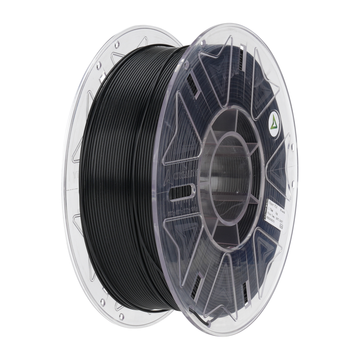
Many materials are hygroscopic; they absorb water from the air and form steam bubbles during extrusion. Store unopened rolls in airtight containers with silica gel and dry opened spools for a few hours at the temperature prescribed by the manufacturer. AC PRODUCTS uses moisture sensors at the printer intake that block the start if the measured percentage becomes too high. This allows you to make optimal use of the selected filament and prevents porous layers or brittle weld seams.
Aligning slicer profiles for consistent results
Extrusion temperature, cooling air, layer height, and retraction speed form an integrated system. For every spool, AC PRODUCTS provides a tested profile for common slicers. After that, you only need to adjust small machine-specific variations, such as microsteps or nozzle offset. Through this working method, you no longer need to discover via trial-and-error which parameters fit the new filament, significantly shortening the time between idea and usable part.
Document, evaluate, and improve per batch
After completing a project, AC PRODUCTS registers material characteristics, printer settings, and measurement data in a central database. With every repeat order, that data can be retrieved and, if necessary, adjusted based on feedback from the field. This way, you build your own knowledge base step by step and reduce dependence on loose notes. A consistent process in which the right filament is central ensures that future prints are just as reliable as the first successful series.


Leave a comment