


You want parts that fit, are strong enough for daily use, and look sleek without half a day of post-processing. That result doesn't start with post-treatment, but with material selection and the way you handle it. Anyone who combines the right filament with a well-thought-out design and stable process settings achieves a higher and, above all, reproducible quality level with fewer test pieces.
Material chemistry: The basis of performance
Polymer families differ significantly. PLA is rigid and dimensionally stable at moderate temperatures, PETG offers toughness and better impact resistance, and ABS and ASA tolerate heat and, in the case of ASA, sunlight. Nylon is wear-resistant and strong, while TPU is flexible. Translate your application into properties: clips require toughness with a bit of stretch, brackets require rigidity and temperature resistance, and show models require aesthetics. Formulation and additives complete the package. A silky-smooth blend behaves differently than a matte one, even within the same family. For instance, the same g-code can yield a different finish and layer adhesion with a different filament.
Moisture control: The invisible success factor
Many materials absorb moisture. Nylon and TPU do so rapidly, but PLA and PETG also react noticeably. Damp material hisses audibly, forms micro-bubbles in the extrusion, and causes porous walls and brittle snap-fit tabs. Store spools airtight with desiccants and note the date of opening. For critical work, dry the material beforehand according to the manufacturer's guidelines. A dry spool of filament often immediately provides higher tensile strength, quieter layers, and a smoother surface.
Diameter, ovality, and consistency
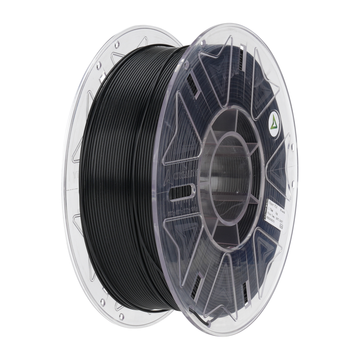
A stable feed determines whether lines in the outer wall are equally strong throughout. For 1.75 mm, a tolerance range of approximately ±0.02 mm works significantly better than a varying strand. Ovality disrupts flow with micro-fluctuations that you see as thin banding. Measure new spools on two axes and recalibrate flow if necessary, especially when switching brands or batches. Filled variants (glass, carbon, minerals) also require a hardened nozzle and a short test print, because additives affect melt viscosity and thus line thickness. A consistent spool of filament then prevents a lot of rework.
Layer adhesion and orientation: Where parts really break
FDM parts are anisotropic: within a single layer, the continuously printed strand is generally stronger than the adhesion between layers. That makes placement in the build chamber crucial. Orient a part so that dominant forces run through strands rather than perpendicular to layer boundaries. If necessary, slightly increase nozzle and bed temperature and decrease cooling in critical segments. More perimeter walls often yield more gain than extra infill, because the outer skin carries much of the bending stiffness.
Speed, temperature, and cooling: The process triangle
High speeds save time but shorten the fusion time between paths. A few degrees of difference determine how long the melt remains viscous enough to fuse properly. PLA performs with relatively high cooling, PETG strings if there is too much air and benefits from moderate ventilation, while ABS, ASA, and nylon require stillness and a draft-free environment. Start with a conservative profile, build up in a controlled manner, and document every change. Every filament reacts differently to this triangle, so small test prints pay for themselves quickly.
Flexible material: Flexibility without breaking
"Soft" does not automatically mean durable. Two TPU spools with the same Shore value can have different rebound or creep properties. For flexible parts, a straight material path in the printer, minimal retraction, and low print speed are often key. Dryness remains important; damp TPU prints "gummy" and becomes brittle faster in use. Anyone wanting flexible work that lasts combines appropriate geometry (radius, ribs) with a suitable filament and calm process settings.
Finishing: What you see and what you feel
Surface quality is created by machine stability, clean flow, and formulation. For a smooth visible surface, a small layer height, low outer perimeter speed, and a line width that logically fits your nozzle work best. Position the Z-seam consciously and keep the nozzle tip clean. If you want a matte, silk-gloss, or "satin" effect, choose a filament that provides this optically so that post-processing can be limited. ABS can be vapor smoothed, while PLA and PETG are more likely to require controlled sanding and primer.
Workshop routine for repeatability
Maintaining quality is primarily about discipline. Label spools with opening dates, store them dry, start on a clean bed, check the first layer visually, and log nozzle hours. Simple QC on dimensions and appearance teaches you early on when something is drifting. Those who also consciously choose predictable filament see the failure rate drop and lead times shorten. Sustainability here primarily means: fewer misprints and less residual waste.
Practical checklist for more targeted selection and tuning
- Determine application: temperature, load, outdoor use, tactile feel.
- Choose the material family and formulation (matte, silk, filled) that fit best.
- Organize dry storage and, where necessary, pre-dry.
- Check diameter and ovality, calibrate flow per brand and batch.
- Optimize orientation and wall thickness before increasing infill.
- Tune speed, temperature, and cooling as a trio per material.
- Control finishing with layer height, seam placement, and perimeter speed.
- Log results with fixed test prints per chosen filament.
How AC PRODUCTS helps you with this
Material selection only really works if it fits your printer, environment, and goal. AC PRODUCTS links applications to concrete advice: which polymers are promising, which nozzles and starting settings are logical, and how to practically set up storage and test prints. If you work with filled or flexible materials, we supply the right wear parts and a short protocol that you can maintain even on busy days. This is how you translate theory into predictable production, with parts that are strong, easy to assemble, and look professional.
Conclusion
Strength, flexibility, and finish are not a coincidence. You influence them with material knowledge, moisture control, consistent feed, a stable print climate, and smart geometry. Anyone who chooses consciously, tunes calmly, and documents consistently turns a single spool of filament not into a gamble, but into a reliable production line. That is the difference between "it worked" and "it works every week."
View the extensive range and get inspired by AC PRODUCTS.


Leave a comment