


No matter how precisely an FDM printer is calibrated, without the right filament, the end result will fall far short of the digital promise. It melts, solidifies, and adheres layer by layer until a usable object is created; at the same time, it determines the strength, dimensional accuracy, and even the appearance. In this guide of over a thousand words, you will discover how a well-considered choice of material, correct moisture management, and smartly adjusted printer profiles together make the difference between frustration and a print that is ready for immediate use.
Polymers with character
Thermoplastics come in countless varieties. PLA prints easily and has a low melting temperature, but loses rigidity above fifty degrees Celsius. ABS remains strong at higher service temperatures, although it requires a closed chamber to prevent warping. PETG combines flexibility with chemical resistance; ideal for outdoor housings or parts that occasionally get wet. By pre-defining the forces and temperatures to which the end product will be exposed, you reduce the chance of starting with the wrong construction material.
Constant diameter = Constant flow
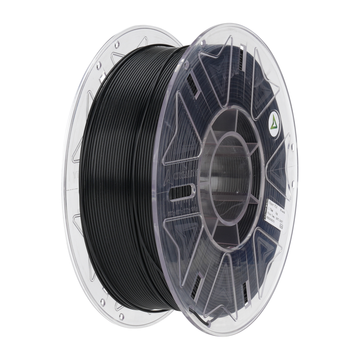
Diameter fluctuations cause under or over-extrusion, resulting in visible ridges and weak walls. Premium brands measure continuously with lasers during extrusion and keep the deviation within ± 0.02 mm. Cheaper suppliers sometimes dare to put ± 0.10 mm on the label or state nothing at all. Therefore, look not only at price, but also at measurement certificates and a tightly wound spool. This minimizes the risk of nozzle clogs before the first layer is even laid.
A summary of five critical questions for the first print
- What will the function be? Whether it is a prototype, art object, or heavy-duty part, every application has its own requirements for the filament to be chosen.
- Does it fit the printer hardware? Nylon and polycarbonate require a hotend that reaches 260 °C and a bed of at least 90 °C.
- How large is the model? Materials with low shrinkage stress limit cracking in high layers.
- Are there environmental regulations? Contact with food or electronics may require FDA or UL certification.
- Does post-processing fit into the workflow? PVB can be polished with alcohol vapor; fiber-reinforced variants require a hardened nozzle.
Moisture: the silent saboteur
Thermoplastics are hygroscopic: they absorb water from the ambient air. When melting, this moisture evaporates into micro-steam bubbles that weaken the extrusion and create a rough surface. Store an opened spool in an airtight box with silica gel or dry the material for two hours at sixty degrees. Some professional print shops even invest in heated drying cabinets; this ensures stable production quality, regardless of season or humidity.
Additives and special blends
If you want more than standard mechanics, composites are worth it. Wood-filled PLA adds organic texture; carbon fiber nylon provides almost aluminum-like stiffness without high density. Keep in mind that the very fine fibers wear down the nozzle, which requires a hardened or ruby tip. Pigment also has an influence: dark shades absorb heat, which can sometimes allow the printing temperature to be five degrees lower without sacrificing layer adhesion.
Printer settings tailored to fit
Datasheets provide a bandwidth, for example 200 - 220 °C, but every printer has its own sweet spot. Start in the middle, print a calibration tower, and refine in increments of five degrees. Pay attention to gloss, stringing, and layer adhesion. Adjust the fan: PLA requires cooling, while ABS does not. Save the final profile so you can get the same quality from every new spool without lengthy testing.
Filament storage and planning
Upon delivery, check the vacuum packaging and the desiccant bag. Label each spool with the date and work according to FIFO (first in, first out). Print shops with high turnover often install a moisture-controlled cabinet where multiple rolls are ready to enter the machine without issues. This prevents half-year-old inventory from suddenly dragging down your success rates.
Failure costs as a hidden factor
A cheap kilo may seem attractive, but add in a failed eight-hour print: wasted electricity, labor, and unnecessary plastic waste. Quality material reduces waste and requires less post-processing. Those who produce in series will notice that the higher purchase price per kilo is more than offset by fewer rejections and shorter lead times.
Looking to tomorrow
Innovations focus on sustainability and performance. Bio-based PLA blends reduce the CO₂ footprint, while continuous fiber technology achieves tensile strengths that approach metal. AC PRODUCTS follows these developments closely and tests new categories before they reach the market. This way, you will soon be able to rely on a ninth and tenth generation of filament that is not only printable but also circular.
Filament conclusion
A successful 3D print begins at the spool level. By choosing polymers consciously, keeping moisture under control, and refining printer settings, you fully utilize the possibilities of modern FDM systems. AC PRODUCTS delivers material quality, datasheets, and practical advice in one package. With the right filament, stored correctly and carefully profiled, the printer transforms from an experimental device into a reliable production tool that lays down every layer just as strong and precise as the last.


Leave a comment