


Do you want to see functional prototypes or end-use parts roll straight off your 3D printer without the need for test prints? Beyond a reliable machine, you primarily need a consistent material. One spool that prints perfectly and the next that causes stringing or layer separation: for many users, that is a daily reality. It is precisely at this weak point that Polymaker distinguishes itself from the crowd. Thanks to strictly controlled raw materials, a wide pallet of engineering grades, and packaging that keeps moisture out, this brand delivers the predictable flow that accelerates your workflow and makes it more professional. In this comprehensive guide (approximately 1,450 words), you will read how the production process is set up, why you can prevent nearly all print problems with one routine, and how AC PRODUCTS helps you get the most out of every spool.
Why raw material control is half the battle
Many budget brands buy their polymers on the spot market. The composition differs per batch and the melting temperature sometimes varies by five degrees. Polymaker, on the other hand, works with fixed suppliers and analyzes every granule for viscosity and moisture content before it enters the extruder. As a result, the diameter tolerance is ± 0.02 mm and the ovality is often even lower. Less variation means more uniform extrusion: your nozzle pressure remains stable, layer lines fuse better, and the risk of “zebra banding” drops to virtually zero. An additional advantage? Less nozzle stress. A uniform filament requires a constant speed from the extruder motor; peaks only occur with deviations in filament thickness. By eliminating these peaks, you extend the lifespan of gears, stepper motors, and the hotend. An investment in quality therefore saves you not only misprints but also maintenance costs.
From PolyLite PLA to carbon-reinforced nylon
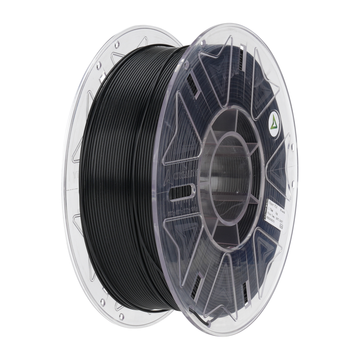
The brand owes its reputation to universal PLA, but the portfolio is now much broader. PolyLite series offer affordable material for concept models; the PolyMax line focuses on impact resistance and heat resistance. For high-performance applications, Polymaker supplies PA-CF (carbon nylon) and PET-CF, both suitable for technical parts that must continuously withstand 100 °C. Thanks to comprehensive datasheets and validated slicer profiles, you can put new materials into production within an afternoon. Surprises in glass transition temperature or layer adhesion are avoided because the mechanical values are reproducible.
Manage moisture, your biggest print enemy
Filament is not allowed to leave the warehouse until the internal moisture percentage is lower than 250 ppm. Nevertheless, even vacuum-packed material can attract water after opening. That is why Polymaker delivers every spool in a multi-layer aluminum bag with an indicator. If that indicator turns pink, you know the spool needs to be dried. A practical routine:
- Store opened spools in a sealable box with silica gel.
- Dry engineering grades (nylon, PTT, TPU) for 6 hours at 65 °C.
- Place the end of the filament strand in a PTFE holder to minimize condensation from the air.
If you adhere to these cycles, print quality remains unchanged even after six months of storage—a point on which lesser brands rarely score.
Print speed without compromising on detail
Modern Core-XY printers reach accelerations of 20,000 mm/s². Filament must therefore heat up quickly and cool down evenly. The crystal modification that Polymaker adds during extrusion increases thermal conductivity and prevents under-extrusion at high volumetric flow rates. In practice, this means you can print 0.4 mm layer widths at 300 mm/s while retaining details. For offices that go through multiple iterations per day, this reduces time-to-prototype by dozens of percent.
Case study: Drones in small series
A start-up that supplies modular drone frames replaced SLA prototypes with carbon-nylon prints on a Bambu Lab printer. The material was Polymide-CF from Polymaker, chosen for its stiffness and weight. After ISO tests on vibration frequency, the frames proved to be 15% lighter yet just as strong as their aluminum counterparts. Thanks to reproducibility, the QA department only had to measure one piece per batch; the rest met specifications based on process capability. The switch saved four weeks of tooling and 40% in material costs.
Sustainable and traceable
Quality is great, but sustainability counts. The brand publishes a Life-Cycle Analysis and recycles “out-of-spec” material into internal spool cores. In collaboration with AC PRODUCTS, Polymaker offers a take-back program: turn in empty spools, receive a discount on new ones. This way, you reduce plastic waste and present customers with a tangible green initiative.
AC PRODUCTS: From purchase to optimization
Good filament is only as useful as your printer’s settings. AC PRODUCTS therefore provides a digital starter kit with every spool: slicer profiles for Prusa, Bambu Lab, Ultimaker, and Creality, plus short videos for correct drying temperatures. Is something not working? Our technical helpdesk is ready to assist. Those looking to scale up to series production can participate in our material workshops or book an on-site audit, where we fine-tune slicing, nozzle selection, and cooling. This is how you consistently get the maximum out of Polymaker and your hardware.
Conclusion
Print quality stands or falls with stable material. By investing in precisely formulated polymers, strict moisture management, and comprehensive datasheets, Polymaker delivers a filament line you can trust, whether you are printing concept models, end-use parts, or small production series. Combine that with the support and knowledge of AC PRODUCTS, and you transform 3D printing from an experimental hobby into a predictable production process. Choose quality today and experience how consistent prints increase the speed and return on investment of your projects.


Leave a comment