


You have invested in a solid 3D printer, the software is running smoothly, and the first prototypes are rolling off the build plate. Yet you notice that one model warps, while another turns out brittle during testing. In nine out of ten cases, the cause is not the machine, but your choice of filament. After all, one spool is not a universal solution; every project places unique demands on strength, temperature, surface quality, and not least, your production schedule. In this comprehensive guide, you will learn how to systematically select the right filament, which parameters really make a difference, and how AC PRODUCTS takes the burden off your shoulders along the way.
Never start at the webshop, but with the function
Successful material selection starts with a sharp project definition. Will the part be an aesthetic exhibition model that primarily needs to shine in a display case, or does it need to function as a gripper finger running 100,000 cycles in a 50 °C production line? Once you have the operational conditions in writing, you can compare them against the technical datasheet values of each filament. AC PRODUCTS summarizes these datasheets into a matrix, so you don't get lost for hours in marketing jargon but see at a glance what range of tensile and flexural strength is truly required.
Understand the material families
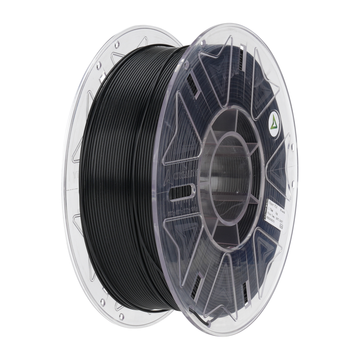
PLA is easy to print, biodegradable, and barely hygroscopic. PETG offers more toughness and chemical resistance, although it can string during fast travel moves. ABS or ASA withstand higher temperatures, but require an enclosed chamber and ventilation to handle the fumes. Nylon scores high on wear resistance but absorbs moisture like a sponge. Then there are the composites: carbon or glass fiber-filled filament for stiffness, ESD variants for electronics housings, and flexible materials like TPU for shock absorption. Once you know the core characteristics, you can quickly filter your options down to two or three candidates.
Check the hardware limits
Your printer plays a role too. A Bowden setup with a PTFE liner stops at approximately 245 °C; exotic PEEK or PEKK variants that require 360 °C are then excluded. If you do not have a hardened nozzle, carbon-filled filament will eat through the opening within a few kilos. And without a heated bed of at least 100 °C, ABS remains a source of frustration. AC PRODUCTS offers a quick scan where we match your printer specifications to a list of compatible materials, including advice on nozzle upgrades or enclosures if you wish to expand your arsenal.
Take moisture seriously
Many printing problems turn out to be simply moisture-related in hindsight. Nylon, TPU, and a number of technological PET blends absorb enough water in 24 hours to cause hissing sounds, bubbling, and poor interlayer adhesion. Therefore, store opened spools in a dry box or dry them for two hours at 60 °C before printing. We supply reusable vacuum bags and silica packs, plus a digital hygrometer that shows at a glance whether your filament is print-ready.
Optimize slicer profiles per material
Once you have the right filament, the fine-tuning begins. Temperature, cooling, and speed affect bonding strength, shrinkage, and surface. Start with the median value from the datasheet, print a calibration tower, and vary in steps of five degrees. Pay attention to gloss, stringing, and bridging. Don't forget the fan curve: PLA requires maximum cooling, ABS requires minimal, and PETG falls in the middle. Document the winning profile for each spool so that colleagues can replicate it later without guesswork.
A summary of five crucial selection criteria
- Temperature resistance: maximum service and glass transition temperature.
- Mechanical load: tensile and flexural strength, impact resistance.
- Chemical and UV resistance: required for outdoor applications or contact with oils.
- Wear or friction requirements: think of gears, plain bearings, or hinges.
- Regulations: food grade, biocompatibility, ESD, or flame retardancy.
If a filament scores insufficiently on one of these axes, you can confidently set it aside.
Integrate material management into your workflow
Weighing a spool by hand to see if there is enough material left sounds handy but is prone to error. Connect your printer farm to a simple MES dashboard instead: you see real-time consumption, remaining quantities, and print progress. AC PRODUCTS provides plugins for most OctoPrint and Klipper suites, including automatic reorder alerts when a critical filament drops below 20%.
Think in cost per part, not in price per kilo
A kilo of PLA is cheaper than a kilo of PETG-CF, but if the PLA part breaks prematurely and you have to print it again, the total cost is higher. Therefore, include machine hours, waste, post-processing, and lifespan in your calculation. We are happy to calculate this for you: often, the more expensive engineering-grade filament proves more economical in the end because the part lasts longer or replaces a CNC process.
Circular printing from support to raw material
Scrap and failed prints still end up in the trash too often. However, when collected separately, PLA and PETG can be excellently ground into regranulate. AC PRODUCTS takes back your waste streams, sorts them by polymer type, and has them converted into test filament. This lowers your environmental footprint and provides marketing-proof evidence of circular production.
Practical case: tooling for the food industry
A mid-sized packaging company was looking for replacements for aluminum form-fit molds that could withstand CIP environments (80 °C, caustic cleaning). We recommended PPS-GF filament: chemically resistant, heat-resistant up to 220 °C, and FDA compliant. After a test print and mechanical test, the pilot series ran continuously for three weeks. The new tool cost a third of the CNC variant, reduced delivery time by four weeks, and the weight decreased by 70%, which reduced operator strain.
AC PRODUCTS: more than a box mover
- Material advice: personal session in which we match project, printer, and regulations.
- Starter kits: mini spools (250 g) for cost-efficient testing without bulk purchasing.
- On-site training: one-day workshop on slicer tuning, maintenance, and quality control.
- Service contract: annual nozzle set, hot end check, and calibration report.
This is how we ensure that your filament choice does not end at the door, but continues until successful series production.
In conclusion: From spool to success
The right match between project and filament takes 3D printing from ‘trial and error’ to a predictable production process. By clearly defining the end goal, respecting your hardware limits, and taking moisture management seriously, you place every layer correctly the first time. AC PRODUCTS is ready to guide you with advice, tooling, and recycling solutions. Do you want to experience immediately which filament makes your next design stronger, lighter, or more sustainable? Request a free material scan or test kit. After that, you print with confidence and your printer with maximum efficiency.


Leave a comment