


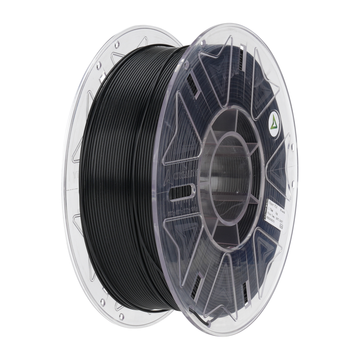
If you print daily, you want predictability. You want your first prototype to come off the machine just as clean as the tenth. That starts with the material. With Polymaker, you choose a stable foundation where diameter, spool winding, and moisture control are consistently in order. The practical result: less calibration hassle, less warping, and a surface that convinces you after just the first few settings. Whether you are printing a visual model or a housing that will be post-processed later, a reliable flow brings peace of mind to your entire process.
What "consistent" means technically
Consistency is more than just a nice word. It is about tight diameter and ovality tolerances, a clean melt without micro-bubbles, and a formula that reacts predictably to cooling. That is exactly where Polymaker stands out. A constant line thickness translates into clean walls and corners, which you will notice immediately with fittings or snap-fit joints. Retraction and bridging also react predictably, so you do not have to rewrite your profiles for every color. It may sound minor, but it saves you a lot of testing time in total.
Detail representation and dimensional accuracy in practice
Most designs do not require a spectacle, but rather repeatability. Think of a faceplate with text, a press mold for a small part, or a mock-up that needs to be on the table tomorrow. Material that delivers the same flow with every layer provides sharp edges and neat transitions. Polymaker makes that control tangible: thin walls fit better, drill holes remain round, and dimensions stay within the margin you intended in CAD. You have to compensate less in the design and can see faster whether a functionality works.
Efficiency in your workflow
Your printing time is not just machine hours, but also everything around it: maintaining profiles, labeling scraps, planning post-processing. When the base material is predictable, it streamlines the whole process. With Polymaker, we see that support settings are more transferable between projects and that you have less need to create unique profiles for every single part. After all, a stable melt curve means you only need to fine-tune your bed and nozzle temperatures to a limited extent. This allows you to iterate faster, which ultimately increases the quality of your decisions.
Material selection without headaches
Sometimes you mainly need a sleek presentation model, other times a tough part for daily use. You do not want to change your entire setup every time. Polymaker offers variants for aesthetics, toughness, and flexibility, but with a similar processing logic. This allows you, using the same machine and nozzle, to easily switch between, for example, a high-quality aesthetic PLA and a more impact-resistant option for test parts. Less of a learning curve per roll, more focus on the design and the application.
Storage, drying, and packaging
Moisture is a silent killer for layer adhesion and surface quality. A roll that has been left open for too long results in a dull finish and unpleasant sputtering in the nozzle. Polymaker addresses this with neat packaging and a spool winding that unrolls smoothly, reducing the peaks your extruder has to manage. If you also store it in a sealed box with desiccant, the quality remains constant, and you can still rely on the same flow months after first opening it. A little discipline, a big effect on your scrap rate.
Settings: How to reach the next level quickly
You do not want to spend an hour searching for the sweet spot. Start smart and work in small steps. With Polymaker, a starting point of moderate layer speed and 0.2 mm layer height is a safe choice. Build from there. Pay close attention to the first layer, cooling curve, and retraction length. Keep it simple with one compact checklist:
- Check Z-offset and brims on a clean, grease-free bed
- Start with modest cooling and increase in steps for bridging
- Test retraction with a small tower and watch for stringing
- Explicitly save every successful profile by color variant
- Note nozzle hours and plan timely replacement for abrasive mixes
This keeps things manageable. You get reproducible results faster and don't have to look back to figure out why a previous print turned out so well.
Color, batch, and aesthetics
There is nothing as frustrating as two parts that look slightly different. For presentations and small series, color consistency is important. Polymaker is known for neat pigment distribution and stable gloss per batch, which in practice means that panels fit together well. Combine that with minor post-processing, for example, a quick flame polish on flat surfaces or a fine sanding pad, and you get a result that convinces without spending hours on it. Aesthetics thus become a manageable part of your planning instead of a gamble.
Buying at AC PRODUCTS: Expert guidance that looks beyond the box
Material selection never stands alone. You work with a specific machine, nozzle, ambient temperature, and target application. At AC PRODUCTS, we therefore pair you with the right roll and the right starting profile. Do you work in an open frame, semi-enclosed, or fully enclosed machine? Are you primarily looking for presentation models or tougher functional samples? Together, we choose the Polymaker variant that fits and establish the foundation in a concise profile. This way, you do not have to start from scratch every time, and the learning curve remains short. If you later require a different property, we build upon that rather than starting over.


Leave a comment