


A 3D printer on the desk is no longer a rarity these days. Yet, the quality of the end result still depends largely on the filament used. Whereas hobbyists once settled for random budget spools, demanding users now look for brands that combine reliability and innovation. The Chinese-American brand Polymaker has built exactly that reputation in a short time. In this article of approximately 1,100 words, you will discover which features make this manufacturer a favorite among designers, engineers, and educational institutions, and how you can get more out of your printer with the right material choice.
Consistent diameter, predictable prints
Nothing is as frustrating as a print that gets stuck halfway through due to varying filament thickness. Polymaker invests in precise laser measurement during the extrusion process, keeping the tolerance usually within ±0.02 mm. The result is an even flow, a lower risk of nozzle clogs, and higher surface quality. Especially for functional parts—think of gears or connecting flanges—a constant diameter means less post-processing and waste.
Research and development as a core activity
Instead of simply selling PLA in fashionable colors, Polymaker focuses on improving formulas. Their joint R&D team in Shanghai and Houston experiments with crystallization speed, chain length, and additives for impact resistance. This led to PolyMax™ PLA, which is up to nine times stronger than standard PLA while still printing at a low temperature. For you, this means less warping without compromising mechanical properties.
Specialties that expand your possibilities
In addition to classic PLA and PETG, Polymaker offers niche materials. PolySmooth™ creates transparent parts thanks to a patented PVB polymer; ideal for lampshades or cosmetic prototypes. PolyMide™ PA-CF combines nylon with carbon fiber for maximum stiffness with minimal deformation, perfect for drone frames or functional tooling. You no longer have to choose between exotic but unstable material: the manufacturer provides print profiles for popular slicers, so the new filament performs optimally after just a few adjustments.
Reliable spool and packaging
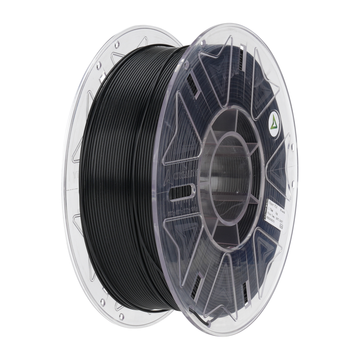
Many problems arise even before the printer starts: moisture in the filament causes bubbles and weak layers. Polymaker vacuum-packs every spool with desiccant and even delivers some high-end lines in reusable resealable bags. The spool itself is wound tangle-free, which means so-called "crossovers" or knots almost never occur. AC PRODUCTS stores the rolls horizontally in climate-controlled warehouses, so you can start immediately upon delivery without a drying cycle.
Compatibility with heated build platform and closed chamber
Although PLA can usually be used without a heated bed, technical materials place extra demands. Polymaker clearly labels which minimum bed temperature is required and whether a closed print chamber is mandatory. PolyMide filaments have proprietary Warp-Free™ technology that regulates crystallization; users report up to 80% less warping than with traditional nylon. This allows you to print larger parts on FDM printers that are limited in chamber temperature, increasing the ROI of your existing machine fleet.
Sustainability and environmentally conscious design
In a world where plastic waste is a growing problem, Polymaker takes sustainability seriously. The PolyTerra™ range uses natural minerals as filler, meaning the material uses less petroleum per kilogram and composts faster under industrial conditions. Cardboard spools reduce plastic packaging; for every roll sold, the manufacturer plants a tree via One Tree Planted. You are therefore making not only a technically sound choice, but an ecologically responsible one as well.
Support and documentation
Nothing is as costly as downtime due to unexplained printer errors. Via the Polymaker website, you will find print profiles for Ultimaker Cura, PrusaSlicer, and Simplify3D, plus video tutorials on nozzle temperature, fan speed, and nozzle choice. AC PRODUCTS additionally offers a helpdesk with Dutch-speaking advisors; a well-tuned machine means less test material and higher production output.
Cost versus value
A common criticism is that Polymaker seems more expensive than budget brands. However, if you include rejection and reprint costs in the calculation, the balance often shifts. One failed eighteen-hour print wastes dozens of euros in material and electricity. The risk of this decreases significantly with a filament that flows and adheres predictably. Also, keep in mind that mechanical strength or transparency is sometimes lacking in cheaper options, forcing you to start over anyway with a better material.
Practical example: Functional end-use part
A transport company in Eindhoven replaced a broken plastic gear in its sorting machine. Using PolyMide™ PA-CF, they printed a replacement part within four hours that was 30% stronger than the original. Combined with minimal after-shrinkage, the dimensional tolerance remained within 0.1 mm without post-processing. The machine was down for less than one shift, which more than compensated for the higher material costs. This shows how strategically deploying Polymaker yields immediate profit.
Conclusion
It is not without reason that the rapidly growing community of 3D makers is increasingly choosing Polymaker. Constant diameter, innovative material blends, environmentally conscious production, and clear support together form a value package that goes beyond color on a spool. By investing in quality, you limit failure, save time, and achieve results that impress both customers and yourself. AC PRODUCTS is ready to guide you in this, so that every print is the step forward you envision.


Leave a comment