


Using a PLA filament 3D printer? These are the biggest benefits
Are you curious about how to create professional prints with minimal effort? With a PLA filament 3D printer, you can achieve a sleek result after just the first calibration. PLA melts evenly, shrinks very little, and adheres well to a clean bed. This is precisely why the startup process is so relaxed: you don’t need to immediately tinker with high bed temperatures or enclosed cabinets. In practice, this means fewer failed prints, less waste, and, most importantly, more peace of mind while learning and scaling up.
What exactly PLA is, in plain English
PLA is a thermoplastic based on renewable resources, often derived from corn or sugarcane. It is sturdy enough for prototypes, enclosures, and visual models, while being user-friendly at the same time. A PLA filament 3D printer benefits from this: you work with lower temperatures than with many other materials, which prevents parts from warping easily. And yes, you notice that immediately on the surface. Edges remain crisp, text and logos come through clearly, and details stay visible without aggressive post-processing.
The most important benefits at a glance
You want an overview. Below are the advantages you will notice day in, day out when working with a PLA filament 3D printer:
- Low processing temperature with stable flow for consistent layers
- Low odor and a pleasant printing environment at home, in the office, or in the classroom
- Minimal deformation, which often allows large flat parts to succeed without issues
- High dimensional accuracy and sharp corners, ideal for fit tests
- Wide range of colors and effects: matte, silk, transparent, filled
- Compatible with open build chambers and simple cooling, which saves energy
Print quality: Dimensionally accurate, sleek, and predictable
When you need parts to work together, repeatability is more important than a one-time perfect print. A PLA filament 3D printer gives you exactly that predictability. Because PLA barely shrinks, click connections and mounting holes fit your CAD model better. Thin walls also print reliably, provided you logically choose the line width and number of outlines. A quick practical tip: start with 0.2 mm layer height and only increase the print speed once the first layers are lying perfectly. This is how you build confidence in your own process.
Workflow: Iterate quickly and decide faster
A prototype is primarily a decision-making tool. A PLA filament 3D printer helps you get the first variant on the table before lunch. Try it on, shift something slightly, test two sizes, and move on. The pace of testing often determines the pace of your project. Because PLA cools down quickly and is sturdy enough for handling, you can do multiple iterations in a day without having to upend your entire schedule. That provides breathing room, even when the deadline is closer than you would like.
Safety and environment: Printing where people are
Not every workplace has an enclosed cabin or industrial ventilation. With a PLA filament 3D printer, you can print responsibly in an office or educational environment, provided you follow basic rules: ventilation, a clean print bed, and no unnecessarily high temperatures. PLA releases fewer pungent odors than many technical materials, which lowers the barrier for new users. The result is a pleasant learning and working environment where you can focus on design and application rather than boundary conditions.
Comparison with alternatives: When PLA wins
Every material has its moment. ABS and nylon score on heat and impact resistance; PETG is tough and more moisture-resistant. Nevertheless, a PLA filament 3D printer is the most productive choice in many scenarios. For visual models, scale models, enclosures without heavy thermal or mechanical load profiles, and presentation models, PLA is faster, neater, and cheaper. If you later have functional requirements that exceed what PLA can offer, your design will already be validated, and you can switch to a more technical filament in a targeted manner. Validate smartly first, then scale up.
Environment and material care: Bio-based yet realistic
PLA is bio-based and therefore a step in a more responsible direction. That does not mean you should just throw it into the green bin. It requires industrial composting conditions that are usually unavailable at home. Sensible material use begins with prevention: with a PLA filament 3D printer, you prevent a lot of waste due to the high success rate per print. Keep rolls dry in a sealed container with a desiccant, label your scraps, and reuse support material where possible. This keeps printing not only affordable but also thoughtful.
Settings and material selection: How to avoid hassle
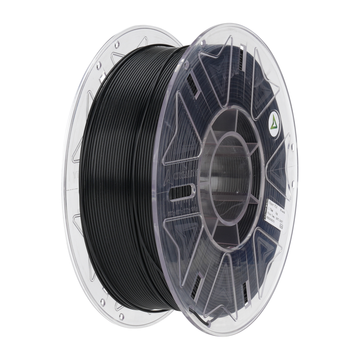
The best results come from a few simple choices. Choose a diameter with strict tolerance, for example, 1.75 mm with a deviation of at most ±0.02 mm. Start with a nozzle temperature around 200 to 210 degrees and a bed temperature of 50 to 60 degrees. Calibrate the flow with a single-wall test and visually check the first layer. With this approach, you will get consistent quality out of every PLA filament 3D printer. And one more thing: save your profiles per brand and color, as pigment can subtly influence the melting behavior.
Applications: From product presentation to education
What matters is that you communicate your idea convincingly. A PLA filament 3D printer is ideal for mock-ups with sharp details, click models for fit checks, trade show presentations, and custom holders for photography and reviews. PLA also works well in education due to its predictable adhesion and calm printing behavior. Students learn faster what does and does not work, without you having to stand by the machine every hour. That is a gain, in terms of both time and motivation.
Buying from AC PRODUCTS: Advice that looks beyond the box
Material selection can never be seen apart from your application. At AC PRODUCTS, we help you choose the right roll, matching your nozzle, extruder, and desired finish. Do you want matte for less visible layers or gloss for presentations? Do you have an open frame or a semi-enclosed machine? Together, we determine which PLA filament 3D printer settings give you the best starting point. And when you want to move on to composites or special effects, we ensure your foundation remains sound. Not complicated, just well-managed.
In summary: Build confidence first, then accelerate
You want predictable prints, a quiet workplace, and a short learning curve. That is exactly where the PLA filament 3D printer excels. The low barrier to entry, the neat surface finish, and the dimensional accuracy make PLA the logical first choice for many projects. Start with simple settings, document what works, and scale up afterward. Honestly, that is the fastest route to lasting quality.


Leave a comment